Asphalt Breaking Point Test methods reveal how pavement binders behave when temperatures fall and flexibility disappears. This 2026 guide examines the Fraass breaking point test, low-temperature bending tests, and complementary rheological methods. Each method exposes a different failure moment. Some show cracking directly. Others measure stiffness before damage becomes visible.
In practical laboratory work, a prepared asphalt film may curl over a chilled steel plate. A small crack can appear suddenly, even when the surface looks uniform. That detail matters. Sample thickness, cooling speed, bending rate, and operator judgment can change the result. Therefore, this guide treats the Asphalt Breaking Point Test as evidence, not an absolute verdict. Results should be compared with penetration, softening point, viscosity, and low-temperature stiffness data.
Dr. R. N. Traxler, a respected bitumen researcher, stated, “Bitumen testing is meaningful only when the test conditions represent service conditions.” This principle remains useful today. A laboratory number cannot fully reproduce traffic, moisture, oxidation, or repeated winter cycles. It can still identify warning signs.
The following sections explain test purposes, equipment, specimen preparation, temperature control, reporting practices, and common interpretation errors. They also compare traditional breaking point procedures with modern performance-based testing. Some conclusions may remain uncertain. That is normal in asphalt research. Reliable engineering requires careful measurement, transparent limitations, and the willingness to question attractive results.
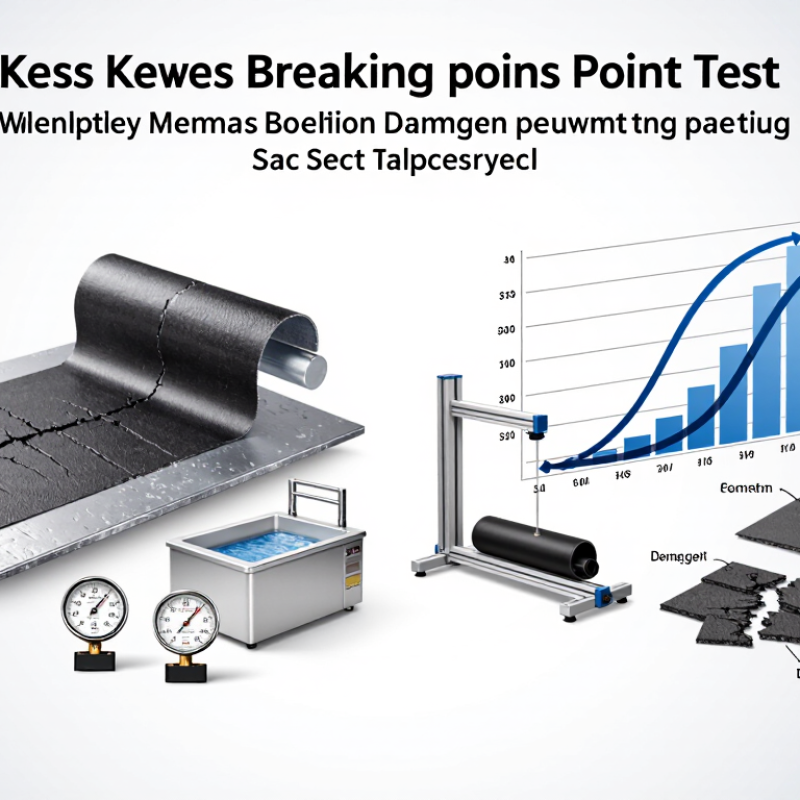
Asphalt Breaking Point: Definition, Purpose, and Testing Principles
Asphalt breaking point is the temperature at which asphalt binder becomes brittle and cracks under controlled bending or cooling. It indicates how the binder may behave during cold weather. A lower breaking point usually suggests better resistance to thermal cracking. However, one value cannot describe an entire pavement.
The test commonly cools a thin asphalt film on a metal plate. The coated plate is bent at set temperature intervals. Technicians record the temperature when the first visible crack appears. This principle connects temperature, stiffness, and cracking risk. Proper conditioning matters. Small differences in film thickness, cooling speed, or surface preparation can change the result. Results should be compared only with the relevant testing standard and specification.
Tips: Keep the sample uniform and inspect it under steady lighting. Calibrate the temperature sensor before testing. Run repeated specimens when possible. A single result may look exact, but it can hide handling errors. I would also record unusual cracking patterns instead of discarding them. Those details may reveal poor adhesion, uneven coating, or an unstable cooling process. Experienced laboratories review both the number and the test appearance. That extra judgment is not perfect, but it improves reliability.
| Test Type | Material Tested | Primary Purpose | Core Testing Principle | Main Measured Output | Typical Temperature Range | Common Standard or Method | Interpretation |
|---|---|---|---|---|---|---|---|
| Fraass Breaking Point Test | Asphalt binder film | Determine the temperature at which a binder film becomes sufficiently brittle to crack during cooling and bending. | A thin binder-coated steel plate is cooled at a controlled rate and repeatedly bent. The breaking point is reached when the binder film develops the first visible crack. | Fraass breaking point temperature, reported in °C | Usually approximately 0 °C to −35 °C, depending on binder grade and equipment capability | EN 12593 | A lower breaking-point temperature generally indicates better resistance to brittle cracking at low temperature. |
| Bending Beam Rheometer Test | Asphalt binder | Evaluate low-temperature stiffness and relaxation behavior of the binder. | A molded binder beam is subjected to a constant load at a selected low temperature. Deflection is recorded over time to calculate creep stiffness and the rate of stress relaxation. | Creep stiffness S and m-value at 60 seconds | Commonly tested at temperatures near the expected pavement low-temperature design condition | ASTM D6648; AASHTO T 314 | Lower stiffness and a higher m-value generally indicate improved ability to relax thermal stresses. |
| Direct Tension Test | Asphalt binder | Measure the tensile strain capacity and failure stress of a binder at low temperature. | A dog-bone-shaped binder specimen is pulled at a controlled rate until it breaks. The test evaluates whether the binder can sustain thermal contraction without tensile failure. | Failure strain, failure stress, and failure temperature | Typically conducted at low temperatures selected for the binder’s performance grade | ASTM D6723 | Higher failure strain generally suggests greater resistance to low-temperature tensile cracking. |
| Thermal Stress Restrained Specimen Test | Compacted asphalt mixture | Directly assess the temperature at which a restrained asphalt mixture cracks under thermal contraction. | A specimen is held at nearly constant length while its temperature is reduced. Thermal stress increases until the specimen fractures. | Cracking temperature, fracture stress, and fracture temperature | Often covers subzero temperatures relevant to the project climate | EN 12697-46 | A lower cracking temperature and higher fracture stress generally indicate stronger resistance to thermal cracking. |
| Low-Temperature Four-Point Bending Test | Asphalt mixture beam | Characterize the mixture’s stiffness, tensile strain response, and fatigue or fracture behavior at low temperature. | A prismatic mixture beam is loaded in bending at a controlled temperature. The resulting stress, strain, stiffness, and crack response are analyzed. | Flexural stiffness, tensile strength, strain at failure, and fracture energy | Selected according to the mixture design and pavement climate | Applicable national or laboratory-developed low-temperature mixture procedures | Lower stiffness combined with adequate strength and failure strain is generally favorable for crack resistance. |
| Semi-Circular Bend Fracture Test | Asphalt mixture specimen | Evaluate crack initiation and propagation resistance using a notched mixture specimen. | A semicircular specimen with a notch is loaded until fracture. The load and displacement history are used to calculate fracture resistance. | Peak load, fracture energy, flexibility index, or fracture toughness | Can be performed at low, intermediate, or project-specific temperatures | ASTM D8044 and related fracture-testing procedures | Higher fracture energy or an appropriate flexibility index generally indicates improved resistance to crack growth. |
| Thermal Cycling and Crack Observation | Asphalt binder, mastic, or mixture | Study repeated cooling and warming effects that may cause progressive crack development. | The material is exposed to controlled temperature cycles while deformation, stress, acoustic response, or visible cracking is monitored. | Crack initiation temperature, crack length, crack density, and accumulated damage | Project-specific cycles spanning the expected seasonal temperature range | Research, comparative, or project-specific laboratory procedure | Useful for comparing thermal durability, although results require consistent specimen preparation and cycling conditions. |
It is the temperature where asphalt binder becomes brittle and develops a visible crack during controlled cooling or bending. Lower values often indicate better cold-weather flexibility. One number cannot describe the whole pavement.
Technicians coat a thin, uniform asphalt film onto a metal plate. They cool it gradually, bend it at set temperatures, and record the first crack. Steady lighting helps reveal tiny fractures.
It helps estimate the risk of thermal cracking in cold conditions. Asphalt may contract as temperatures fall. If it cannot relax stress, cracks may appear.
Film thickness, cooling speed, surface preparation, and temperature calibration can shift the apparent result. Small handling differences matter. The test is useful, but not perfectly stable.
No. Binder tests use controlled samples and simplified loading. Pavement behavior also depends on traffic, moisture, aging, air voids, and construction quality. Laboratory certainty can be misleading.
Creep stiffness and relaxation tests show how a binder manages stress. Direct tensile testing measures failure strain. Mixture tests examine crack growth in compacted asphalt specimens.
A low failure temperature may suggest stronger cold-weather resistance. Engineers should also review stiffness, tensile strength, air voids, aging, and cooling rate. Borderline results deserve repeat testing.
Use at least three specimens when the testing method allows it. Repeated results can expose preparation or alignment errors. A single clean result may hide problems.
Record mixing temperature, coating condition, cooling time, conditioning duration, and unusual crack patterns. Crooked fractures or uneven surfaces may reveal poor preparation. Do not discard strange results too quickly.
The test shows behavior under specific laboratory conditions. It does not fully reproduce seasonal exposure or field construction variability. Asphalt rarely behaves perfectly, and interpretation requires judgment.
Asphalt breaking point describes the temperature and conditions at which asphalt materials become brittle and crack under stress. This guide explains the purpose of the Asphalt Breaking Point Test and the principles behind evaluating low-temperature fracture resistance. It introduces major test types, their suitable applications, and the differences between direct loading, cooling-based, and bending-related approaches. By understanding these methods, engineers can select an appropriate procedure for pavement materials, binders, and mixtures.
The guide also covers specimen preparation, dimensional control, conditioning, and essential testing equipment. It presents a clear step-by-step process, including temperature reduction, load application, crack observation, and accurate data recording. Finally, it explains how to interpret breaking temperature, failure behavior, and related measurements to assess low-temperature performance. These results can support material comparison, mixture optimization, and practical decisions for improving pavement durability in cold environments.

 Zealchon Electronic