High-Quality Automatic Triaxial Test Soil Laboratory Equipment Pricelist, Quotes

The ASTM and BS standards model can be tailor made.

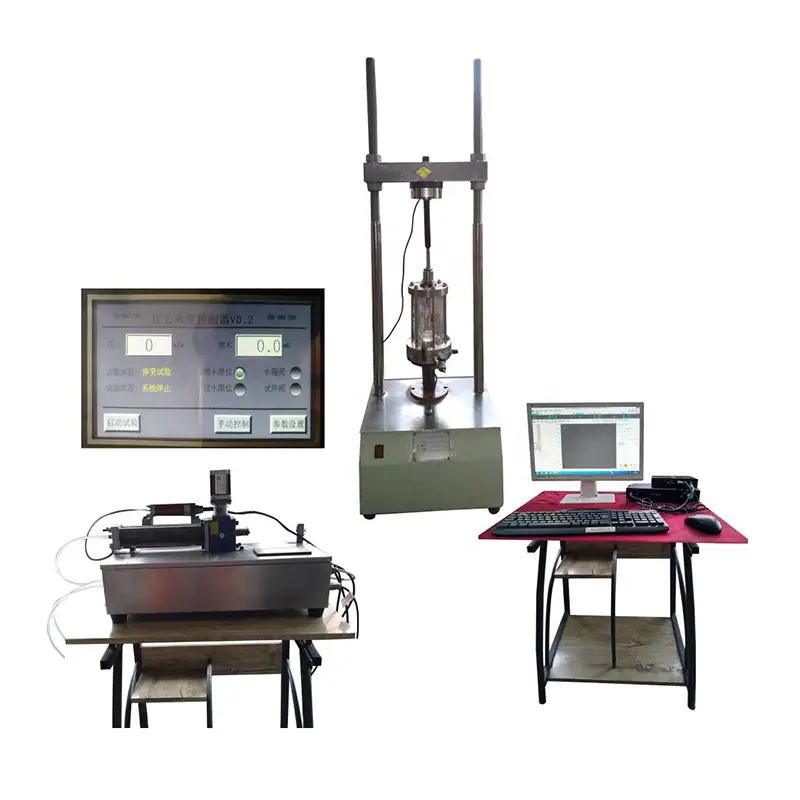
Soil Triaxial Test is an experimental device used to determine soil mechanical properties, widely used in the fields of geotechnical engineering, geological engineering, and civil engineering. Strain Triaxial Tester is mainly used to simulate the mechanical behavior of soil under different stress states, evaluate the strength, deformation characteristics, and stress-strain relationship of soil.

Features: The hydraulic system for confining pressure and backpressure control adopts a "precision digital piston", which can not only apply confining pressure and backpressure, but also measure body deformation and drainage, with a resolution of 1mm3 (cubic millimeters). Even if backpressure is applied, there is no need for measuring tubes and body deformation tubes, no need for drainage and body deformation sensors, no need for manual reading and recording operations. The pipeline adopts quick couplings, the container automatically injects water, and the drainage device is easy to operate. It can produce various outputs such as constant pressure and constant rate, cyclic pressure and volume changes, linear changes over time, etc. as required.

Product Description

Product Specifications
Model NumberC001
Surrounding pressure0-2MPa ± 0.1kPa LCD display computer control
Axial compressive force0-10KN, 0-30KN, 0-60KN, 0-100KN (optional)
Axial deformation0-20mm ± 0.01mm
Strain rate0.001-4.5mm/min with stepless speed regulation and adjustable settings
Specimen size39.1mm, 61.8mm, 101mm (Confining pressure cylinder Optional)
Stress rate10N~30KN/S, adjustable arbitrarily
Power supply220V 50Hz
Product nameAutomatic Triaxial Apparatus
Lifting stroke0-60mm
Counter pressure / Pore pressure0-2MPa ± 0.1kPa LCD display computer control
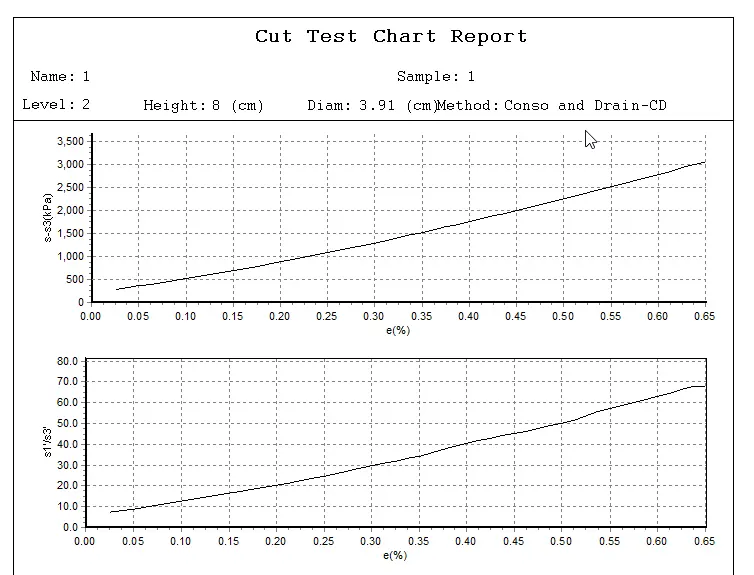
Control systemWindows data acquisition and processing software, supports networking, compatible with existing computer systems, fully automatic computer control, software acquisition and data processing, exportable data and graphics.
Product Advantages
🎯
High Precision

Accurately control stress state and measure deformation. Simultaneously test soil strain and stress across multi-paths to achieve uniform pressure.

🛠️
Multifunctionality

Supports multiple testing modes and is suitable for different types of soil samples.

🏗️
Real Simulation

Able to simulate the stress and strain state of soil in actual engineering conditions effectively.
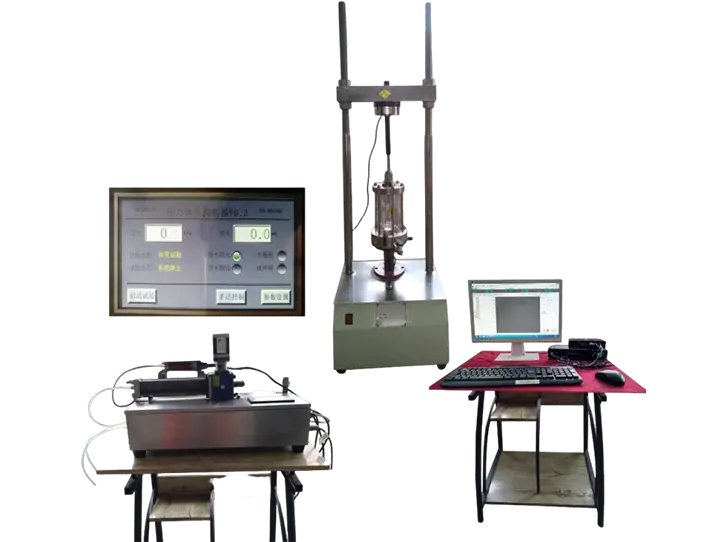
Automatic Triaxial Apparatus Main
Product Description

This triaxial Soil Test device provides a comprehensive method for measuring the shear strength of soil. It typically utilizes 3-4 cylindrical specimens subjected to different constant surrounding pressures to shear until failure. Based on Mohr-Coulomb theory, users can obtain shear strength parameters, triaxial creep, triaxial permeability, lateral compression coefficients, and unconfined compression strength.

The system determines total and effective shear strength parameters for fine-grained and sandy soils. It supports three major test types: UU (Unconsolidated Undrained), CU (Consolidated Undrained), and CD (Consolidated Drained).

Advanced Testing Capabilities

The system features automatic control of surrounding pressure during shearing, calculation of tangent modulus, and real-time cyclic control technology to correct axial deformation errors.
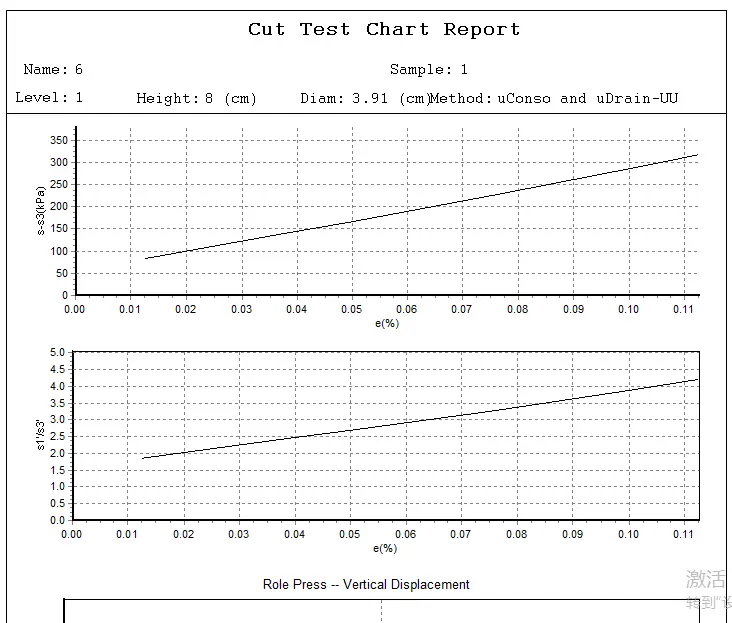
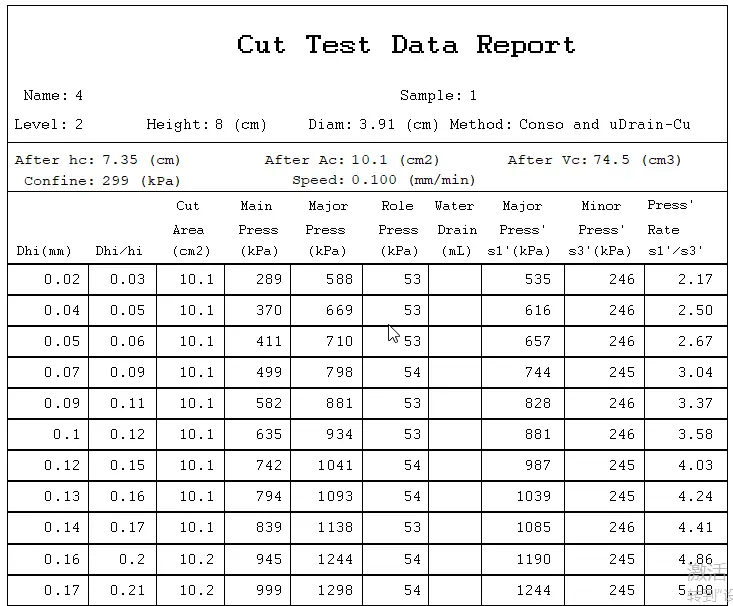
UU Test
UU: Unconsolidated Undrained Test
CU Test
CU: Consolidated Undrained Test
CD Test
CD: Consolidated Drained Test

K0 Conditions: Generation of pore water pressure dissipation coefficients and percentage under ambient or axial pressure (suitable for cohesive soils with saturation >85%).
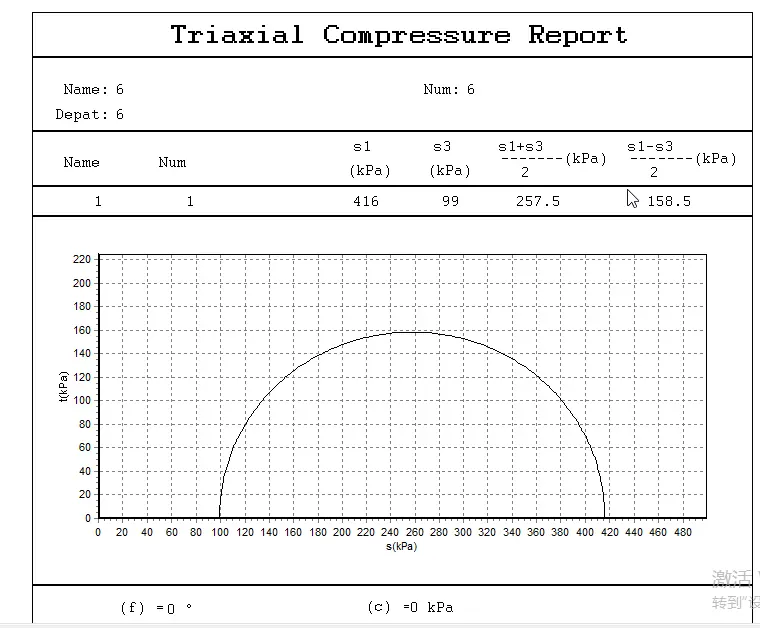
K0 Conditions

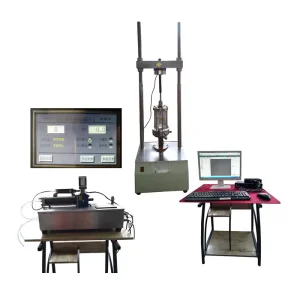
Key components include a high-precision controller, specialized software, sensors, and robust pressure systems (confining, back, and pore pressure).
Frequently Asked Questions
Q1: What standard tests does this fully automatic three-axis system support?
A: Our system fully meets mainstream geotechnical standards including ASTM D2850, ASTM D4767, ASTM D7181, BS 1377-6, and GB/T 50123-2019. It supports UU, CU, and CD tests, as well as isotropic/anisotropic consolidation (K0) and complex stress path tests.
Q2: How is control accuracy ensured under varying confining pressures?
A: The system uses closed-loop servo control. Axial loading is driven by high-precision servo motors (0.0001 to 9.9999 mm/min). Pressure control utilizes digital hydraulic servo controllers with an accuracy of ± 1kPa or ± 0.1% full range, ensuring minimal drift.
Q3: How accurate are volume change and pore water pressure measurements?
A: We use high-resolution digital volume transmitters (up to 0.001ml) for body deformation. Pore pressure is measured via imported high-precision sensors installed directly on the base to minimize pipeline delay.
Q4: How does the system ensure sealing during long-term (multi-day) tests?
A: We utilize low-friction shaft seals and special combinations of leakage sealing rings. All valves and pipelines are constructed from stainless steel or high-pressure resistant PTFE to prevent corrosion and leakage.
Q5: What happens to data during a power outage?
A: The controller features an independent data buffer and hardware protection. If power is lost or the computer crashes, the controller stops safely and retains key data nodes, allowing you to "continue the experiment" once power is restored.
Q6: Is the equipment compatible with different soil sample sizes?
A: Yes, the pressure chamber features a modular design. By replacing the base, pressure head, and split mold, you can test samples ranging from 39.1mm standard soil to 101mm coarse-grained soil using the same host.

Related Products