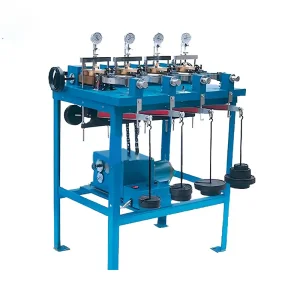
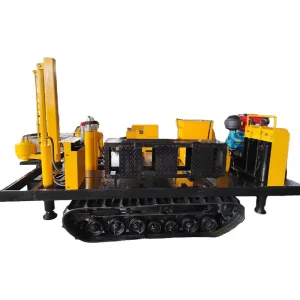
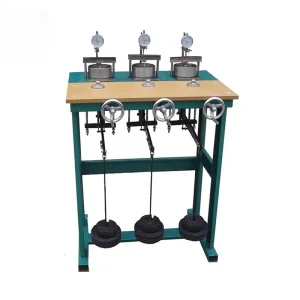
Core Principle
By applying a constant or graded load to a soil sample and measuring the dissipation of pore water pressure and the change in deformation over time under drainage conditions, the consolidation coefficient, permeability coefficient, and other indicators can be calculated.
During the test, the soil sample is typically placed in a rigid or flexible container. Loading can be performed using weights, levers, or air pressure. Drainage conditions can be controlled to single- or double-sided drainage as needed to simulate different engineering scenarios.
Test Purpose
To determine the permeability coefficient of the soil sample as seepage water passes through it, as well as the critical slope at which fine-grained soil gradually loses its water flow (piping), and the failure slope at which the soil mass floats (soil flow). Suitable for disturbing fine particles, sand, clay, and undisturbed soil samples.
Optional functions (flow totalizer): Temperature (°C), Pressure (MPa), Flow rate (factory Nm³/h), Accumulation (Nm³); detailed parameters are in the Engineering Instruments and Measurement category.
Technical Parameter
01
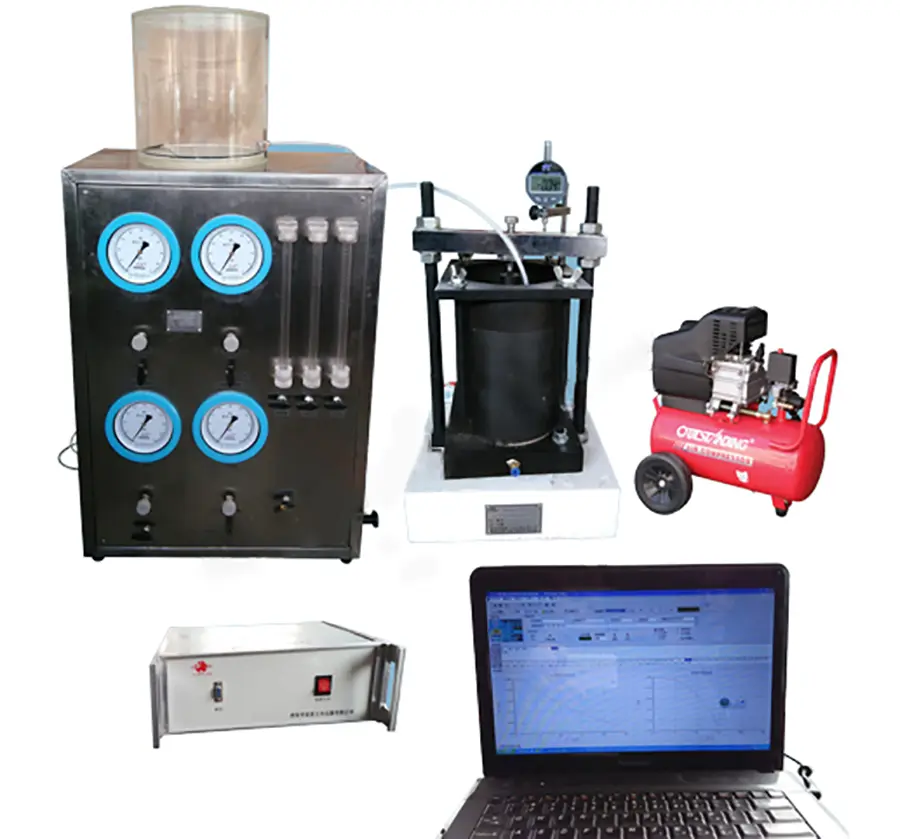
Vertical Permeability Deformometer: Consists of a loading device, frame, pressure regulator, sample tube, top cover, base, permeable plate, pressure sensor, and instrument.
02
Test tube inner diameter: Φ 100mm × 125mm and Φ 150mm × 170mm; other sizes are optional. Constructed from metal steel pipe, with a piston-driven rod in the center of the top cover.
03
Permeable plate apertures: Available in 3mm, 5mm, and 7mm. A sloped permeable plate is installed below the lower permeable plate.
04
Saturated permeability head pressure: Adjustable with an accuracy of 0-1MPa. 0.01MPa.
05
Loading System: Air pressure loading 0-20kN, pressure adjusted according to specimen area and maintained constant.
06
Loading deformation: 0-30mm ± 0.01mm, optional.
07
Pore pressure sensor: 0-1MPa ± 0.2kPa.
08
Permeability meter: 0-200ml ± 0.2ml; optional automatic water permeability coefficient acquisition system (real-time LCD display).
09
Host computer software: Real-time display of consolidation force, deformation, pore pressure, and water seepage, recording, storage, graphing, and export.
Frequently Asked Questions
What types of soil samples can be tested?
This equipment is suitable for testing disturbing fine particles, sand, clay, and undisturbed soil samples to determine their permeability and consolidation characteristics.
What are the available dimensions for the test tube?
Standard inner diameters include Φ 100mm × 125mm and Φ 150mm × 170mm. Other custom sizes can be provided as optional configurations.
How is the loading pressure regulated?
The system utilizes air pressure loading ranging from 0-20kN. The pressure is adjusted based on the specimen area and is designed to be maintained at a constant level throughout the test.
Does the software provide real-time data monitoring?
Yes, the host computer software offers real-time display of consolidation force, deformation, pore pressure, and water seepage, including features for recording, storage, and graph exporting.
What is the accuracy of the pore pressure sensor?
The pore pressure sensor has a range of 0-1MPa with a high precision accuracy of ± 0.2kPa.
Can drainage conditions be modified for different scenarios?
Yes, drainage can be controlled to simulate either single-sided or double-sided drainage conditions to match specific engineering requirements.
 Zealchon Electronic