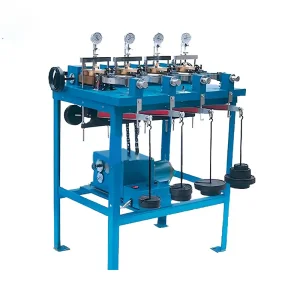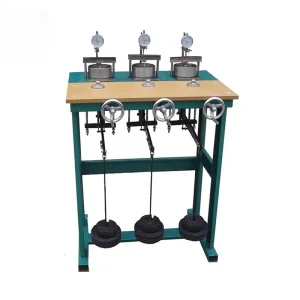
High-Quality Soil Bentonite gradient permeability consolidation tester Manufacturer, Suppliers

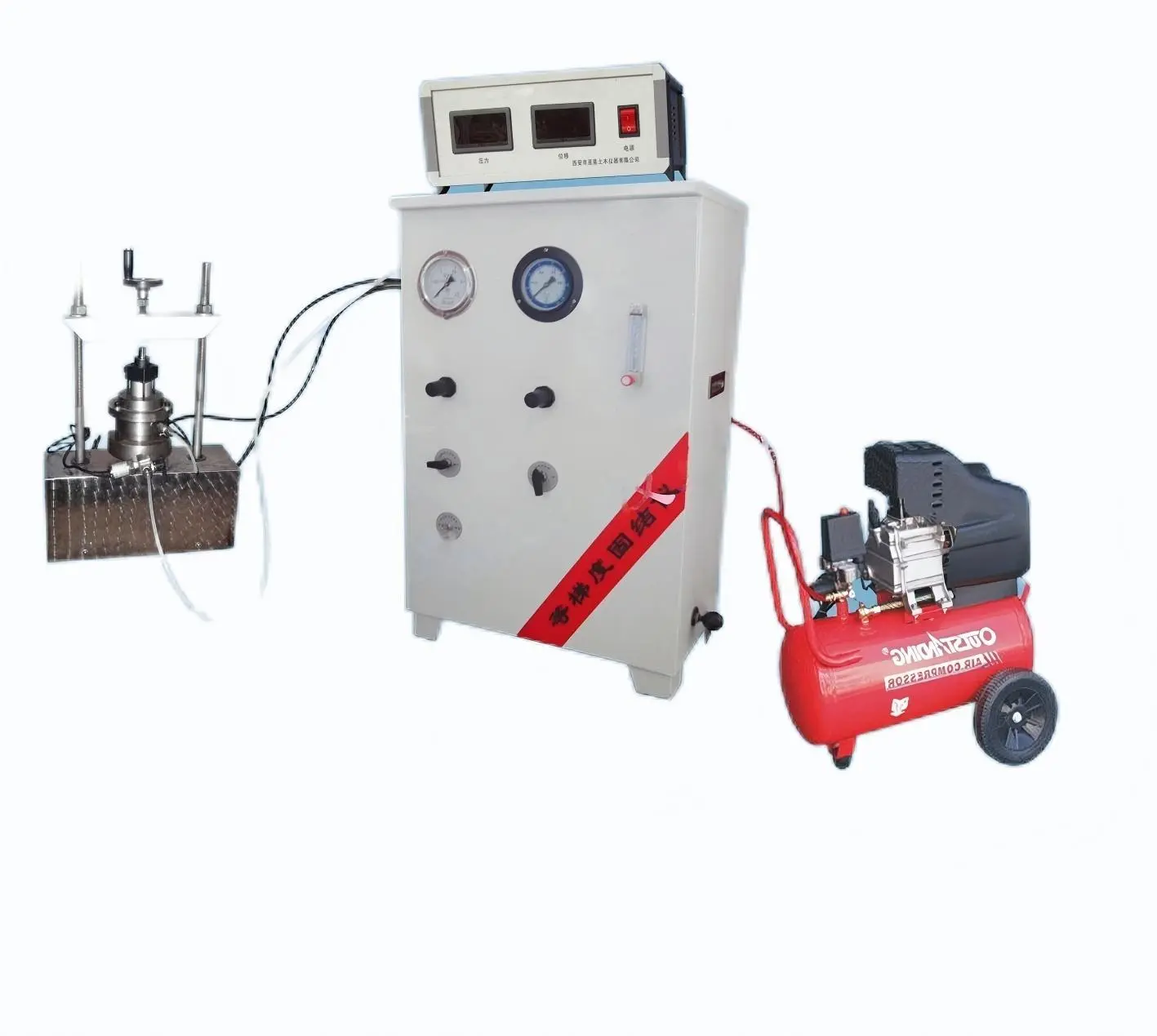
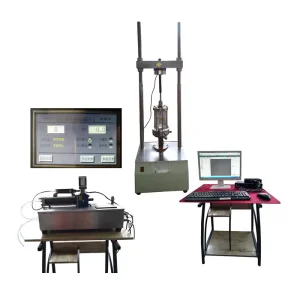
The gradient permeability consolidation instrument is mainly used for the compression permeability and permeability consolidation coupling test of saturated soil. The step-by-step loading adopts a servo pneumatic cylinder as the vertical load power source, and the permeability head pressure is generated by the cylinder and air compressor. A constant head gradient can be set according to the test needs. The instrument is equipped with vertical pressure load, high-precision pressure gauge (optional force sensor), vertical displacement, and pore water pressure sensor.

This device can also perform tests such as collapsible tests on loess, salt expansion and dissolution tests on saline soil, expansion and contraction tests on expansive soil, and permeability tests on cement soil. Suitable for conducting soil mechanics research in higher education institutions, survey and design degrees, etc.

Optional functions (flow integrator): temperature (℃), pressure (MPa), flow rate (factory Nm ³/h), accumulation (Nm ³/h)

Product Description

Product Description
The bentonite gradient permeability consolidation tester is a specialized experimental device used to study the consolidation permeability coupling characteristics of bentonite (such as sodium based bentonite, calcium based bentonite) or other low-permeability soils under gradient permeability conditions. This Soil Bentonite consolidation tester simulates the hydraulic mechanical behavior of bentonite as an anti-seepage barrier in practical engineering, such as landfill liners and nuclear waste disposal buffer materials, to determine its permeability coefficient, consolidation deformation characteristics, and long-term stability.
Working Principle
1. Sample preparation
- Bentonite is compacted into samples according to the predetermined dry density and moisture content, or pre compacted bentonite blocks/pieces are directly used.
- Sample saturation (may require vacuuming or prolonged soaking).
2. Equal gradient infiltration loading
- Apply the same confining pressure at both ends of the specimen (simulating in-situ stress), and then apply a constant head difference through an upper and lower infiltration system to ensure uniform distribution of hydraulic gradient.
- For unsaturated tests, the intake value can be controlled (such as using high intake value ceramic plates).
3. Parameter determination
- Permeability coefficient (k): calculated based on Darcy's law using steady-state flow rate and hydraulic gradient.
- Consolidation coefficient (Cv): obtained by fitting the deformation time curve.
- Expansion/compression characteristics: Analyze the relationship between axial deformation and osmotic pressure.
Technical Parameters
Voltage / Power 220V 50Hz / 2kW
Control System Servo pneumatic valve control (optional air pump)
Large Axial Loading 0-10KN (adjustable constant)
Loading Sequence 200 kPa, 400 kPa, 800 kPa, 1600 kPa, 2000 kPa, 3200kPa
Standard Sample Size Φ 61.8mm × 20mm
Counter Pressure 1000kPa ± 0.01kPa, adjustable (constant)
Pore Pressure 0-1MPa ± 0.01kPa, adjustable
Axial Displacement 0-15mm ± 0.001mm
Display Mode Real-time LCD display for displacement and pore pressure; high-precision gauges for reverse and axial pressure
Frequently Asked Questions
What materials can be tested with this equipment?
It is specifically designed for bentonite (sodium-based or calcium-based) and other low-permeability soils used in anti-seepage barriers.
How is the axial loading applied?
The system utilizes servo pneumatic valve control for precise axial loading up to 10KN, allowing for adjustable constant pressure and specific step-by-step sequences.
Can the system measure pore pressure in real-time?
Yes, the device features an LCD that provides real-time display of both axial displacement and pore pressure with high precision.
What is the standard specimen size for testing?
The standard sample size used in this tester is Φ 61.8mm in diameter and 20mm in height.
What practical engineering scenarios does this tester simulate?
It simulates the hydraulic and mechanical behavior of materials used in landfill liners and buffer materials for nuclear waste disposal.
Is it possible to upgrade the pressure reading system?
Yes, while standard versions use high-precision gauges, sensors can be optionally selected for digital display of reverse and axial pressure.

Related Products