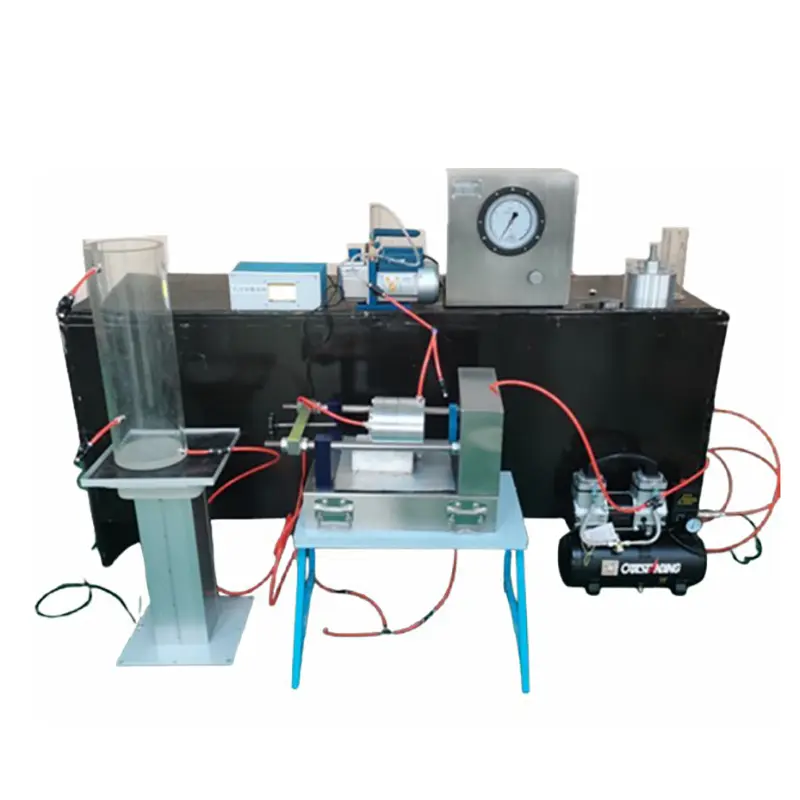
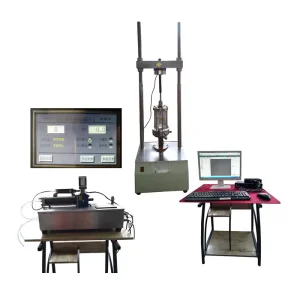
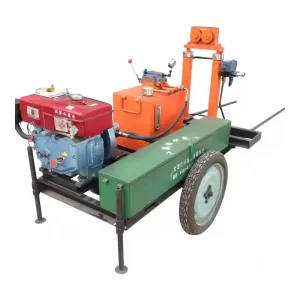
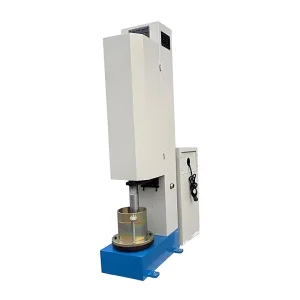
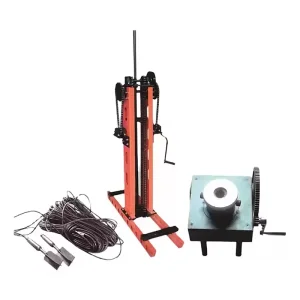
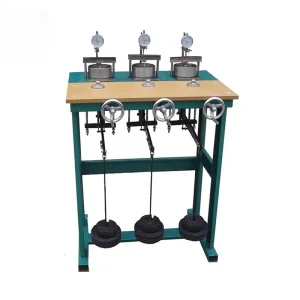
Dispersible clay refers to soil in which the cohesion between fine particles largely or completely disappears in low-salinity water (or pure water), causing the aggregated particles to disperse spontaneously into primary clay particles.
According to the theory of permeability, when water flows through soil pores, it transfers its kinetic energy to soil particles, thus dispersing them. The Pinhole test of dispersible clay simulates the flow rate, color, and pore size changes of water flowing through soil pores under a certain water pressure, reflecting the soil particles' ability to withstand water erosion.
i The test is conducted at room temperature (10–30°C).
1
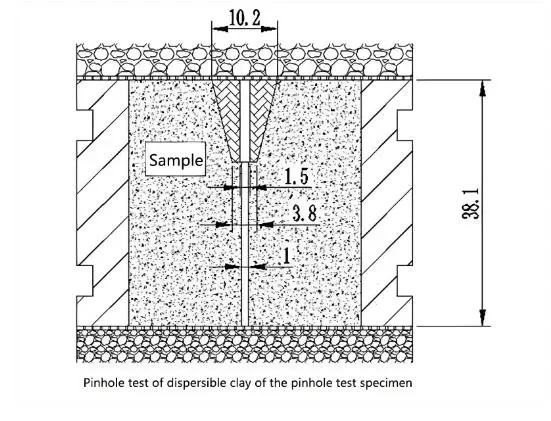
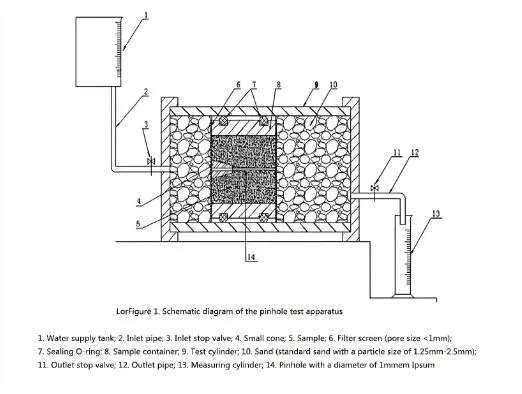
Place a filter screen (pore size <1 mm) and standard sand (particle size 1.25 mm–2.5 mm) at both ends of the sample for the pinhole test.
2
Add distilled water to the equipment to begin the test. Set the initial water head to 50 mm. If using a hose to connect the water tank and testing device, purge the air from the hose, water tank, and testing device before starting the test.
3
Record the time at the start of the test (or start a stopwatch), and measure the volume of water flowing through the sample using a graduated cylinder. If no water flows out at the start of the test, stop the test, open the testing device, and re-drill the hole.
4
Observe the color of the water in the graduated cylinder. The color can be divided into seven levels: very turbid, turbid, somewhat turbid, slightly turbid, visible to the naked eye, clear, and completely clear.
5
Conduct the test at a water head of 50 mm. If the water flowing out of the pinhole appears very turbid after 5 minutes, and the flow rate is 1.0 mL/s to 1.4 mL/s, the test is ended.
6
Open the pinhole testing device, remove the sample, cut it along the direction of the pinhole, and measure the pinhole diameter.
7
If the final hole diameter is greater than 2 mm, the sample is classified as dispersible soil D1.
8
If after 5 minutes at 50 mm head the water is very turbid but flow rate < 1.0 mL/s, continue for another 5 minutes. If then the flow is 1.0-1.4 mL/s and aperture > 1.5 mm, it is D2. If flow is 0.8-1.0 mL/s and aperture ≤ 1.5 mm, it is transitional soil ND4.
9
If water is clear/slightly turbid after 10 mins at 50mm, increase water head to 180 mm. If flow is 1.4-2.7 mL/s and diameter ≥ 1.5 mm, soil is ND3.
10
At 180 mm head for 5 mins, if water is clear, increase head to 380 mm. If it then becomes slightly turbid or flow is 1.8-3.2 mL/s, the sample is classified as ND3.
11
At 380 mm head for 5 mins, if water is clear, increase head to 1020 mm. After 5 mins, if particles are visible or flow > 3.0 mL/s with diameter < 1.5 mm, it is ND2; otherwise, it is ND1.
Permeability Head Gradient Pressure
0–15 kPa, accuracy ±0.5% F.S; minimum head gradient 50 mm.
Pore Pressure (Optional)
0~300KPa, accuracy ±0.5% F.S
Sample Size Options
Φ50×38.1mm; Φ61.8×38.1mm; Φ100×38.1mm
Drainage Receiving Device
0~200ml, accuracy 0.2ml
Melt Deposition Deformation
0~10mm, accuracy 0.01mm (Optional)
Frequently Asked Questions (FAQ)
What is dispersible clay in soil mechanics?
Dispersible clay refers to soil where the cohesion between fine particles disappears when in contact with low-salinity or pure water, causing particles to spontaneously separate.
What is the purpose of the Pinhole test?
The test simulates water flow through soil pores to measure flow rate, color, and pore size changes, indicating the soil's resistance to water erosion.
What is the required temperature for the experiment?
The pinhole test should be conducted at a controlled room temperature between 10°C and 30°C.
How many levels of water turbidity are observed?
The water color is classified into seven distinct levels, ranging from "very turbid" to "completely clear."
What criteria classify a soil as D1 (Dispersible)?
A soil is classified as D1 if, at a 50 mm water head, the water is very turbid, the flow rate is between 1.0-1.4 mL/s, and the final hole diameter exceeds 2 mm.
What water head pressures are used during the test?
The test progresses through various water head levels starting from 50 mm, then 180 mm, 380 mm, and up to 1020 mm depending on the soil's reaction.
 Zealchon Electronic